Monday, 27 January 2014

SUMMIT GOING ON

by Tracy Shaw, Loca Creatives Director

Photo: Dawn Robinson Photography, courtesy of Kirklees Communities and Leisure


What better way to kick the new year into top gear than an afternoon taking "an international, national and local view of how creative thinking, activity and problem solving have found innovative solutions to regeneration, community development and economic growth"? Well done Kirklees Communities and Leisure, for putting on a Creative Summit that offered "world renowned keynote speakers" and brought together dozens from the local creative sector. Those kinds of energising opportunities come round all too rarely.

So with "creativity is the cornerstone of innovation" as the hook for the afternoon, what spurs did we get to go forth, be creative and innovate?

We got some juicy facts and figures. Compelling figures - taken from recently published DCMS Creative Industries estimates - of the kind that make you feel grateful to be working in a booming sector rather than an ailing one (the 2.5 million people employed in the UK's creative economy account for one in twelve of all jobs; the creative workforce has been growing faster than other sectors; creative businesses' GVA accounts for 5.2% of the UK economy). And thought-provoking facts of the kind that make you wonder if current education policy isn't missing a trick - according to Wayne Hemingway's sources, truancy rates at Key Stage 4 are lower in Design than in all other school subjects, and highest in the STEM subjects (on which note you might like to take a look at STEM to STEAM).

We got music.  The Charlie Winston 'Boxes' song that Dr Rita Klapper used to get us thinking about breaking out of habitual thinking and behaviours was pure cheese, but as a device it seemed to work. Contributions from the floor suggested that plenty of people connected with the idea that we too easily get boxed into constraining roles and socially imposed identities when in fact we all have the possibility of being "a thousand me's" - doubtless a reassuring notion for anyone trying to jigsaw together a viable living from 'portfolio working'. The passing round of actual boxes into which unsuspecting audience members were invited to fit themselves perhaps laboured the point a little, but their solutions were all nicely creative and it provided some ice-breaking entertainment for the rest of us. Tellingly, no one came up with the response that Dr Rita was really looking for - refusing to even try.

David Parrish gave us a salutary reminder that creativity is not the sole domain of those who work in the arts sector but is in and around us all; and that Creativity + Innovation won't make a successful business unless you do the hard bit and get your business formula right too. He had wise things to say about the importance of knowing yourself and keeping a sharp eye on your competitive environment, the benefits of co-opetition, the marketing power of the freebie, protecting your creative and intellectual property, and the choices to be made between being a creative labourer and a creative entrepreneur (one makes you money while you sleep, the other doesn't). All good stuff, and all freely available to be dug into more deeply in the eminently readable T-Shirts and Suits - useful back-up for anyone present whose concentration was distracted by the whoooosh on every slide change.

From Wayne Hemingway we got great stories - ones that I imagine he's dined out on quite a bit over the years (while privately wishing he were at home with a bowl of cereal?) but they stand up to the re-telling. His own business start-up story, alongside partner Gerardine (now she sounds like a woman who refuses to be boxed in by fear of the unknown) is an inspirational tale of can-do entrepreneurship for which the phrase 'nothing ventured nothing gained' might have been coined. Fast forward 20 years to the Hemingways' collaboration with Wimpey Homes (Gerardine - "just because we've never designed houses before doesn't mean we shouldn't give it a go") and the start of their award-winning involvement in social housing design. This being an area of particular personal interest, and a direct link to the "bringing innovative solutions to regeneration and community development" bit of the Summit publicity which I'd found so enticing, I was sorry not to get more on this - but Mr H was respectful enough to recognise that more from him would cut the next speaker short. Would it have made a difference if he'd known she wasn't actually going to speak? Anyway, happy to do cereal at mine any time you fancy a further chat, Wayne.

More music - and more cheese, this time of the disco variety - from art lecturer, performer and self-confessed music and social media obsessive, Dr Rebekka Kill. It was late afternoon, the sugar surge from the cake-and-networking break had worn off and we'd been listening to speakers for 3+ hours - but suddenly a room full of heads nodding to the beats, hips shimmying gently in seats. Dr Kill rocked. History will probably never relate whether it was actually white wine in the bottle that she necked her way through, but it introduced an element of edginess into the proceedings. Glugging wine straight from the bottle?!  Before six  o'clock, on a Wednesday?!

 
This wasn't necessarily innovation (it seems djtheduchess has done this gig several times before) but it was a refreshingly novel twist - a whole keynote speaker slot completed with not a word spoken, not even a Q&A. The format meant that the concepts behind the 7" vinyl - conveyed in snappy one-liners via PowerPoint - were condensed almost to the point of oversimplification, but it made for a nicely pithy presentation with certainly enough content to be thought-provoking. Look - it is possible to be a successful hybrid of your various selves, rather than living out your academic days and your disc-spinning nights in different boxes. What will the new forms of social media look like - disco-esque Facebook, punky Twitter, the best bits of both, or neither of the above? I'm not sure that the overriding objective of the event was to leave the audience pondering the question 'So am I Disco or am I Punk?', but it was a great note to end on.

So, we got examples of creative thinking and good advice on being creatively entrepreneurial, in abundance. Did we get innovation, and the impetus to make more of it happen? We did each receive a dinky take-away sample of the hottest in printing technology, courtesy of the 3M Buckley Innovation Centre (check out the A Primer on 3D Printing TED Talk for an eye-opening introduction). But a skip round TED's Innovation category, Nesta's catalogue or Culture Label's publications on creative entrepreneurship (to name but three) might suggest that, at that particular moment in Huddersfield, we were some way away from the cutting edge.  And yet it's all relative, isn't it? I imagine every one of us will have taken away a lightbulb moment, some stimulus, a conversation, a concept or a connection that will prompt us to try something we've not tried before, take a leap in our business, form a new alliance, devise a new project or shake up a habitual way of doing something.

Innovations and creative sparks will emerge from the Summit on our terms and in our own contexts, then. Some will be small and some more significant, game-changing even. How about sharing yours with the rest of us in some way - disco, punk, or whatever works for you?

Tuesday, 17 December 2013

FROM MEXICO, WITH LOVE

We're lucky to have Anni Raw as a Loca Creatives associate, amongst many other things because it gives us access to generously shared blog material inspired by her recent post-doctoral research. Her thesis - investigating 'core practice' amongst artists who work in community and participatory arts - included an exploration of artists’ practice in the UK and Mexico. Thanks to the Centre for Medical Humanities at Durham University for allowing us to re-blog this piece from one of Anni's recent study visits - it originally appeared on CMH's own blog on 25 November 2013. See also her previous guest post for us.
 
Paisaje Social     Photo: Miho Hagino


Witnessing human compassion, connection and resilience, fostered in a harsh landscape of brutal inequality, and noting the contribution and impact of research.

Mexico City is a world of parallel realities – perceived in the extreme by travelling on one of the main autopistas from grand, tree-lined avenues in the cultural centre, out to the fringes on the East, where marginal scavenger communities construct themselves – whole families living literally inside and underneath the city’s rubbish mountains. Or, from convivial cafes and cosy residential courtyards, concealing their palms and passionate bougainvillea behind high street-front doors, taking a short few strides to the brutal night world of the soliciting strip at Nuevo Leon corner, where pin-thin transvestite prostitutes manage impossible heels, bearing the winter chill almost naked to earn pennies inside the black saloons that crawl past. The contrasts in parallel life experiences here are stomach churning.

Within this place are many self-organised groups, passionately keen to touch and highlight the ever-present social injustices. Some use ingenuity and creative skills to make contact with people living beyond the visible city life, as discussed in a previous blog entry, In and Out of Focus, 
in which inmates in a youth prison here in Mexico City were encouraged to make a film of their incarcerated everyday lives. On this trip I have been in close contact with an organisation of artists – ‘Paisaje Social’, roughly social landscape in English – who are beginning to develop sustained partnerships with State-run social institutions such as networks of children’s homes and care homes for the elderly. Working so far without payment but using huge creativity and ingenuity with minimal resources, they run workshops in teams, to create simple new experiences with people, and transform atmospheres and spaces.

My experience attending two workshops, one in a children’s home and one in an elderly care home found artists bringing playful and open-hearted humanity into bleak, dark corners: making small art works, together with groups of up to 20 participants, that reflect back the imagination and creativity people in these institutions rarely have the chance to explore or express. I was intrigued to see such open and uninhibited, tender relationships blossoming, touch and eye contact, laughter and teasing characterising interactions between everybody in the workshops. It’s particularly fascinating to see the cross-cultural interactions at work here: the teams include artists from Japan as well as Mexico, and language functions on many non-verbal and paralinguistic levels, in order to work around missing words or difficult accents, especially important in connections with the older people with dementia. Even my own presence bringing an English accent and another different cultural perspective seemed to enrich rather than disrupt the workshops: curiosity and good will were strong enough to straddle the language confusions. Although the participants themselves, and their works which adorn the shared living areas of the institutions, remain behind the locked doors, Paisaje Social uses a sophisticated website
and social media strategy via Facebook and twitter to enable what goes on in these workshops, as well as the participants and their achievements, to be visible and celebrated in the world beyond.
 
My connection with Paisaje Social began on my last visit here 6 months ago, when one of the three co-founders of the organisation, Miho Hagino, attended a seminar I ran here in Mexico City, to disseminate the findings from my doctoral research for a practitioner audience. Miho saw the seminar advertised by chance, and attended hoping to find useful perspectives on the practice of the Paisaje Social associate artists. She was very inspired by the resonances she felt with the messages from my research, and since then we have been in touch by email. The ensuing relationship is inspirational for both parties: Paisaje Social has taken on with huge enthusiasm my model for how socially engaged arts and arts/health practice can be articulated and theorised, disseminating the ideas, debating their own approaches, and even engaging in dialogues with me about evaluation strategies, and professional development based on my work. For me, to be in touch with an organisation so serious about reflective practice, and finding such useful application for my research is an inspiration and a privilege. It is exactly what any researcher can hope for – that what we commit our focus and efforts to with such intensity can then find a useful application in the real world of practice.

Paisaje Social is an organisation on the march, accumulating knowledge, experience and ambition in how to create new openings for good practice in community-based participatory arts initiatives – I will be in close contact with them, and hope they will become a Mexican outpost in our CMH arts and health network of colleagues and compaƱeros.

Monday, 4 November 2013

ENGAGING WITH COLOUR - Part 2

Last time Lesley Fallais made a heartfelt plea for an educated and informed approach in any situation where decisions about colour will have an impact on the public realm.  Three lovely project examples from her portfolio illustrate how exploring colour and teaching basic colour theory can be a great community engagement device and lead to well considered, locally distinctive design outcomes.
 
The aforementioned library incident and my work on other projects have convinced me of the importance and value of 'colour education' in any design or community involvement situation which impacts on the public realm or streetscape. And as I've got more interested in working with colour and colour theory in my design work with people, I've also discovered what a powerful focus they offer for inclusive, accessible community engagement and tenant involvement activities generally.

For Refresh Berry Brow (with Kirklees Council and Kirklees Neighbourhood Housing), Jane Revitt
and I teamed up with Impossible Theatre and its amazing ChromaVan to work with residents on developing a colour scheme for the repainting of the external render on two tower blocks. It's a useful case study in how a well planned, imaginatively and accessibly delivered creative engagement process around colour choices can support tenant involvement objectives as well as good public realm design. As KNH's Estate Management Officer said several years on: "Refresh Berry Brow created an impetus in the local community and local services to continue the good work that was done.  This meant people wanting to be more involved in determining other projects for their community and deciding what these should be, how they should be created and how they should be managed."

Ravensthorpe in Colour (also for Kirklees Council) was a creative community engagement project which informed the design of a site-specific artwork by Jane and Andy Plant
for a new Library, Information and Children’s Centre. It illustrates well how the idea of people exploring and recording colour can provide a really strong, fun engagement hook through which to connect with many local residents of all ages. In the words of a Library Service manager: "The simplicity and accessibility of the colour theme made it easy for people to take part. The project succeeded in creating a feeling of inclusion and shared involvement."

A third project brings the themes of public realm design, tenant involvement and informed decision making nicely together. On an estate undergoing a massive housing renewal programme where new homes were being built and five ‘retained' streets of old social housing were being refurbished, critical decisions on colour had to be made. Residents in the retained area had said they wanted to keep the existing grey render but this was clearly going to leave the old properties looking monotone and institutionalised against the adjacent new-build ones. I was pleased to be asked to work with Kirklees Neighbourhood Housing staff and other members of a creative project team to involve local people in the development of a colour scheme. As I introduced myself to residents I repeatedly heard “we don’t want it to look like Balamory” - people feared that using colour meant bright, vivid colours that would be totally inappropriate to the location. At the other extreme, I'd seen housing renewal areas where over-cautious choices had resulted in the whole estate being painted white and cream, re-creating the same overwhelming visual monotony and lack of character it had started with. For the retained streets we needed to find a path between the two extremes, create a scheme that was locally appropriate and distinctive, and carry people with us.

With our residents we set about recorded existing local colour, including the colours of the roof slates, local stone and in the surrounding natural environment - lots of rich possibilities for workshops and on-the-street activities there. We considered the layout of the streets and various site lines before mixing paint samples and testing them full scale, in daylight, on the side of some properties. Then we drew up a considered, street by street, block by block colour layout and presented it to the community. Having been through a creative, accessible engagement process residents were no longer fearful of using rich, saturated colours and they didn’t insist on their homes being painted cream. They could clearly see the rationale behind the selection of colours and very readily supported the proposed colour scheme. In this way we were able to challenge the preference for a 'safe', uniform look and visually link the retained properties with both the new housing and the surrounding natural woodland. The result was a striking, well considered and popular transformation of the five streets, and residents who understood, owned and supported the process we'd been through to get there.

I now regularly deliver colour based workshops and professional training, accessible to anyone of any age and useful to people who make decisions about colour in public spaces – architects, NHS professionals and public sector managers have been amongst recent participants. I'm currently developing a colour training package for Loca Creatives that can be tailored to community groups or professionals. I’d encourage everyone to talk a closer look at colour, its use in public spaces and its effects. Some basic colour knowledge goes a long way - in fact I'd say it’s a basic life skill, whether you're selecting a tie to go with your shirt or a cushion to give punch to your interior colour scheme, or are aiming to create the right mood and visual environment for a public space.

Monday, 30 September 2013

ENGAGING WITH COLOUR - Part 1

An understanding of colour is a useful life skill for everyone, and critical for anybody making decisions about the use of colour in public realm design, says our Core Team associate Lesley Fallais. Having worked as an artist and designer on many regeneration projects where enabling intelligent use of and informed choices about colour has been a key aspect of her role, she's used her own learning to develop professional training sessions and community engagement workshops. A training package for Loca Creatives is in the making so we asked Lesley for an appetiser. It was so good we've made it a two-parter - come back soon.
 
As a visual artist working primarily on projects within urban regeneration and with an enduring commitment to sustainable place-making, I've often been shocked at how decisions on something so fundamental as colour are often casually made.

Having found myself drawn into decision making about the use of colour many times, I've made it my mission to learn more about hue, chroma and saturation, and to encourage others to really consider the successful use of colour in community buildings such as libraries, hospitals and schools, in external public spaces, on tower blocks, and on rendered walls and street furniture. For me sustainable place-making and successful public realm design are rooted in the recognition and utilisation of local distinctiveness, leading to a true sense of place. I'm convinced that selecting and using colour in public spaces (along with other key design considerations) has to be set in the context of a unique, contemporary story which records existing local colour, vernacular architecture, landscape and the cultural heritage of a site.

I’ve been lucky to collaborate on a number of significant projects with design professionals who have a real understanding of the use of colour, including designer Jane Revitt who I have seen transform several schools and healthcare environments with an intelligent and considered use of colour. In these contexts colour was used creatively to create an effective healing or learning environment, and to aid navigation around previously bland and institutional looking corridors and spaces. There is also a lot to be learnt from the commercial developers and designers of retail outlets and cafes who give so much attention to how colour affects people and their use of public spaces. If it is important to encourage the public to use, linger and revisit a building or space, theirs is essential thinking.

A few years back, Jane and I collaborated on the design of a series of site-specific artworks for a new community library, with the aim of creatively engaging with local residents and ultimately giving the building some identity which would encourage local people to use and love it. By chance we found ourselves in a meeting which was also making decisions about the building's external colour scheme (not part of our brief). A senior manager, in a laudable effort to include his staff in the building's development, spread out a colour chart and asked his colleagues to ‘choose’ the colours for the exterior window frames, security shutters and doors. I had seen ‘Tenant Choice’ in action many times, where tenants are invited to choose their own colours and finishes for kitchens and bathrooms, and realised in that instant that a similar approach was being used here to make critical decisions about architecture and public space design. Offering Tenant Choice about people's private, domestic interior decor is one thing, but I'm a firm believer that no aspect of public realm design should be ‘chosen’ in a vacuum. 

A secondary but equally important concern for me is that genuine, inclusive, engagement with people should be something much more considered, creative and meaningful, always designed to maximise learning opportunities, develop skills and create ways for people to fully participate in the decision making process. Enabling people to make informed decisions seems fundamental, and surely to make informed decisions about colour in public spaces people - whether as professionals or as residents and users - need some knowledge and understanding of colour, light, local distinctiveness and the unique local context?

Back to the library staff... They were clearly not comfortable about being given responsibility for this ‘choice’: “how should I know what colour to paint the doors and windows?” said one. Sitting in that situation a realisation dawned – is this why so many public sector community buildings often look institutional, with poorly designed interior and external colour schemes (no joke if they then fail and close because people don’t want to use them)? We've all seen the navy blue and black security shutters on youth centres, health centres and libraries that when closed at night look like military bunkers and contribute nothing to the urban townscape. If only we could get away from the standard colour chart and from slavishly sticking to institutional brand designs, and make our colour selections site-specific.

In the library meeting, with some trepidation, I stuck my head above the parapet: “you can’t make decisions about colour like this!” Jane and I were immediately challenged to come up with a colour scheme, urgently needed by the contractor for the following Monday morning. As we are trained visual artists and knew the site well we were able to do this. The project team could clearly see the difference in our approach and we believe the results contributed quite significantly to making the building successful.

On a number of other projects I've had the chance to make exploring and learning about colour an integral part of the community engagement process, and have discovered what an empowering and inclusive - not to mention fun - tool it can be in that respect. A couple of my favourite examples follow next time.

Thursday, 8 August 2013

SETTING THE SCENE: IMAGINATION

We've been keeping tabs on associate Anni Raw's doctorate research into artists' practice in community-based and participatory settings, listening with curiosity and envy to her tales of travel to Mexico as part of this research, and waiting eagerly to see it all published. Imagine our delight when she offered us a series of guest blogs drawing on some of her exploring, deep thinking and deep-reaching conversations with practitioners over the past three years. Here's the first.


Imaginative life-size papier mache sculpture ('alebrije') in Mexico


The process of constructing the set for the animated scene is fascinating. A large box is retrieved from a back room behind the school kitchen, and from it spill numerous oddments which to me look like the leftover remnants of an outdoor jumble sale: several large pieces of rough-cut cloth of different colours and textures, pieces of moss, twigs, a box of small animal figures, two half-formed miniature Pleistocene figures – one of a dog and one a person – and a cardboard model hut with dry mud glued to the roof. This rough paraphernalia contrasts sharply with the high-tech camera and professional lighting equipment being set up on tripods, focus trained on a small table, and at first I am confused: surely a set made from these materials will not be adequate to produce a film of high enough visual quality! Seeing the box, the team of five lads - involved in their customary chaotic behaviour and constantly confrontational interactions - suddenly abandon their hyperactivity to begin building the scene. Bryan helps two of the boys organise cloth, moss and twigs (crumpled cloth backdrop strewn with bits of outdoor woodland material, precariously balanced, and a tiny twig campfire constructed centrally, with what look like orange and red Pleistocene worms protruding through the twigs.) Meanwhile Kath is piecing together arms, legs, bodies and heads of the main character and his dog, with industrious input from the other three lads. They finally draw onto paper and cut out four small circles depicting different cartoon-style facial expressions: smiling, shocked, angry and asleep. The first of these (asleep) is roughly tacked to the head of the small figure, and some brushed sheep’s wool attached above (for hair). He is positioned reclining on a rock by the campfire, his dog nearby. Abdul is at the camera, and meticulously focuses the lens on the ramshackle scene, clicking one shot – meanwhile Imran darts a hand in and bends the Pleistocene fire worms very slightly. Another click. Imran darts in again, another slight tweak: another shot.

The stop-frame scene is unfolding before my eyes, these are the flames of a flickering campfire! The miniature world created by the group becomes more and more real within the pool of light. Yet stand back, and with a dissociated eye it looks like a jumble of rubbish. The earnestness with which the group creates a complete imaginary world from ad hoc bits and pieces here in this large, empty school dining hall is impressive. I am completely drawn in. We have to stop intermittently and laugh when main character Mr Martin’s arm keeps falling off, then his head, and people keep inventing surreal potential storylines to accommodate these minor catastrophes. But we all know they’re just messing about with ideas – each team member is holding the map of the agreed storyboard in their mind’s eye, waiting until the story can proceed. The shared humour feels very bonding. There is one highly surreal, spontaneous development to the plot when a plastic lion figure enters stage left on the inspiration of Imran, in response to which one of the other boys rapidly exchanges Mr Martin’s facial expression to ‘shocked’, and the dog falls over. This moment remains in the film – everyone satisfied that it adds something indefinable.

(Field notes from observation of stop-frame animation project, UK, 31/5/12, quoted from PhD thesis: ‘A model and theory of community-based arts and health practice’, Anni Raw, Durham University, 2013. Artists were Bryan Tweddle and Kath Shackleton; participants’ names are changed to protect their anonymity. The project was part of a family learning initiative by Artworks Creative Communities.)


During the past three and a half years I have had the opportunity and enormous privilege to undertake doctoral research, looking into the creative processes – both seen and unseen – which artists create, initiate, and guide when working with people during community-based participatory arts projects. Based with Durham University’s increasingly renowned ‘Centre for Medical Humanities’, this research was instigated as an element of the centre’s study of the contribution of the arts to public health and wellbeing – how, in fact, is it that artists work with their groups, in order to produce such often remarkable outcomes? The excerpt above is from my observation work, and is used in the thesis to point to the importance of placing the imagination centre-stage – giving time and license to the minute details which allow disorder to become a story. The artists in this work, when working well, support participants’ explorations of their own imaginations. If imagination is a muscle, artists are elite athletes. They train/stretch their own imaginations daily, and are able to model by example the importance of playing with the imagination, so that participants young or old can value their own imaginative capacity. In my study I highlight this as a key element of the way in which artists have a special and valuable contribution to make in enabling people to tap into their own resources for building resilience and making changes in their lives. By ‘working’ the imagination, and in some cases reconnecting people with their imagination when they have lost the ability to flex their imaginative muscles, arts practitioners empower their project participants to ‘dream up’ new perspectives, new outcomes, and new questions, which can shift life into a different gear. Artist Lou Sumray wrote to me recently: ‘I think that most people like to play - they just forget they don’t need permission to do so.’

Over the coming months, and beyond, I hope as a visiting contributor to this blog to share some magical moments from excellent project work. Other reflections on my research can be found on the CMH blog.
 

Monday, 29 July 2013

IN THEIR OWN WORDS

by Tracy Shaw, Loca Creatives Director

The blanket of special gifts      Photo: Talya Rochester


School's out for summer, which brings a momentary lull in our Social and Emotional Health projects with children and young people and breathing space to take stock of, and write up, the past few months' work. There have been projects to support transition and help Year 5 and 6 children prepare for change; projects with a language and literacy focus; projects designed to enable children to explore their identities and the gifts they have to give to each other and their wider community; and an extended programme focused on strengthening family interaction by giving space for children and parents to enjoy family-themed conversations and meaningful time together.

Like a golden thread, continuous reflection has run throughout all the doing and making, talking, laughing and learning - reflection with participants, with school staff, and amongst ourselves as the practitioners managing and delivering the work.  Within all our Social and Emotional Health work reflection plays a crucial part in how we do evaluation, capture the project stories, develop our professional practice, and gather evidence for the obligatory post-project reports that the work is effecting change and delivering tangible outcomes.

Reports are good, of course. They have a value not just in themselves as a means of documenting and promoting the work, but also for how the writing of them helps distil our own learning and inform future project planning. But looking back through the material that's been captured recently through the reflective processes embedded within each project, I'm reminded that there's something to be said, too, for simply letting the voices of participants and close observers speak for themselves.


"We weren't natural leaders at the beginning but we were by the end."

"I wasn't confident with language - working with words gave me confidence."

"J is really benefitting from having opportunities to shine but also learn the consequences of his actions on a small group."

"P had an all round improvement thanks to the project. His interaction is massively better and his self-confidence and self-esteem have increased. He was a target for bullies before but he's much more confident now."

"I feel positive, that's new for me." 

"K wouldn't speak at all before, she didn't have much input, was almost 'invisible'. Now she is speaking her mind and contributing more. She has more confidence."

"L gradually really developed self-control without missing out on the enjoyment. He was able to separate himself from trouble and became more mature."

"I look forward to Thursdays. You can let it all out - all your feelings about High School and things."

"The project helped B to become better at mixing with other children, he got better and better at this as the weeks went by."

"N loved it from day one, always looked forward to the session and was consistently proud of the work he did. He was chosen because he tends to be quite immature and choose friends that are much younger than him, but to us he seem to be the most mature in the group. His confidence and faith in his abilities have really improved."

"J challenged himself every session. He is normally very insular and quiet around others but he shared with the group, was happy to speak in front of everyone and worked really well in partnership. It was great seeing him just chat about general things while he was making and doing. He relaxed with others and the project really helped him to enjoy being with other people."

"M had a safe space to experiment with different aspects of her personality and let her hair down around other children. She cares for younger siblings so it was a good reprieve for her and she had fun."

"This is the beginning of regular rituals for these children and their blanket of special gifts. It will become part of school life and its stories will be their stories."

Friday, 12 July 2013

FLYING THE FLAG

With applause from a mightily successful Field of Flags project finale still ringing in her ears, Loca Creatives Core Team member Mary Robson offers some reflections on Paul Tough's recently published book about child development and 'character-building', makes the links between modern neuroscience and the attachment theory that underpins our Social and Emotional Health projects, and flies the flag for work that creates all-important spaces for conversation.


Given its title How Children Succeed - Grit, Curiosity and the Hidden Power of Character, and its New York Times Bestseller banner, you would be forgiven for thinking this is another self-help manual for middle class parents. However, Tough has consulted educators, economists, psychologists, and neuroscientists who are making connections across academic disciplines and together illuminating the complexities of child development in new ways.

So it isn’t a how-to book, but rather a treatise on why ‘character’ qualities such as perseverance, curiosity, conscientiousness, optimism and self-control are more likely to ensure a child’s success in life than 'cognitive’ teachings.

Tough is an investigative journalist in the States, and his very readable book brings together some compelling evidence. Here is one example:

The effect of good parenting is not just emotional or psychological, the neuroscientists say; it is biochemical.

Neuroscientists’ experiments with rats have led the way to a deeper understanding of attachment. Separated from their mothers at twenty two days, the rats were then tested at maturity. The rats who were licked and groomed more as babies were more likely to independently explore a new cage or eat in an unfamiliar environment.

They were better at mazes. They were more social. They were more curious. They were less aggressive. They had more self-control. They were healthier. They lived longer...When [they] examined the brains of the adult rats, they found significant differences in the stress response systems of the high-LG and low-LG rats, including big variations in the size and shape and complexity of the parts of the brain that regulated stress.

It didn’t matter if it was the birth mother or another rearing rat who did it – it was the licking and grooming that was important, to the point that it ignited the parts of the pup’s genome that 
controlled the way the rat’s hippocampus would process stress hormones in adulthood.

The scientists went on to apply their findings to humans and recent longitudinal studies clearly show that how children are able to handle stress is directly related to the quality of their parenting. And that environmental stressors - overcrowding, poverty, family turmoil - fall by the wayside if your mother is sensitive to your emotional state. So here is the link between modern neuroscience and attachment theory as developed in the sixties.

Of course, this is music to the ears of those of us engaged in community-based arts in health and especially to those of us interested in the social and emotional development of children. It helps to strengthen the theoretical base of our work with children and their families. Whilst early, secure attachment to a parent is ideal, work can be done in later years that can help to ameliorate the effects of insecure attachment.

Tough is clear that we have a big job on our hands. He is advocating the reform of the American education system, and as we well know in the UK, education is a political matter. Conservatives often cry that character is all, and use it to barrack the poor and disadvantaged to “pull yourself up by your boot straps” or “Get on your bike”. But the scientific evidence is that

 . . . the character strengths that matter so much to young people’s success are not innate; they don’t appear in us magically, as a result of good luck or good genes. . . they are moulded, in measurable and predictable ways by the environment in which children grow up.

So we all have a say in the development of our children. Artists, teachers, social workers, clinicians, neighbours all have a part to play. Our communal work is subversive on one level, taking place under the radar of the latest curriculum developments 
that are counter to so much research and practice.

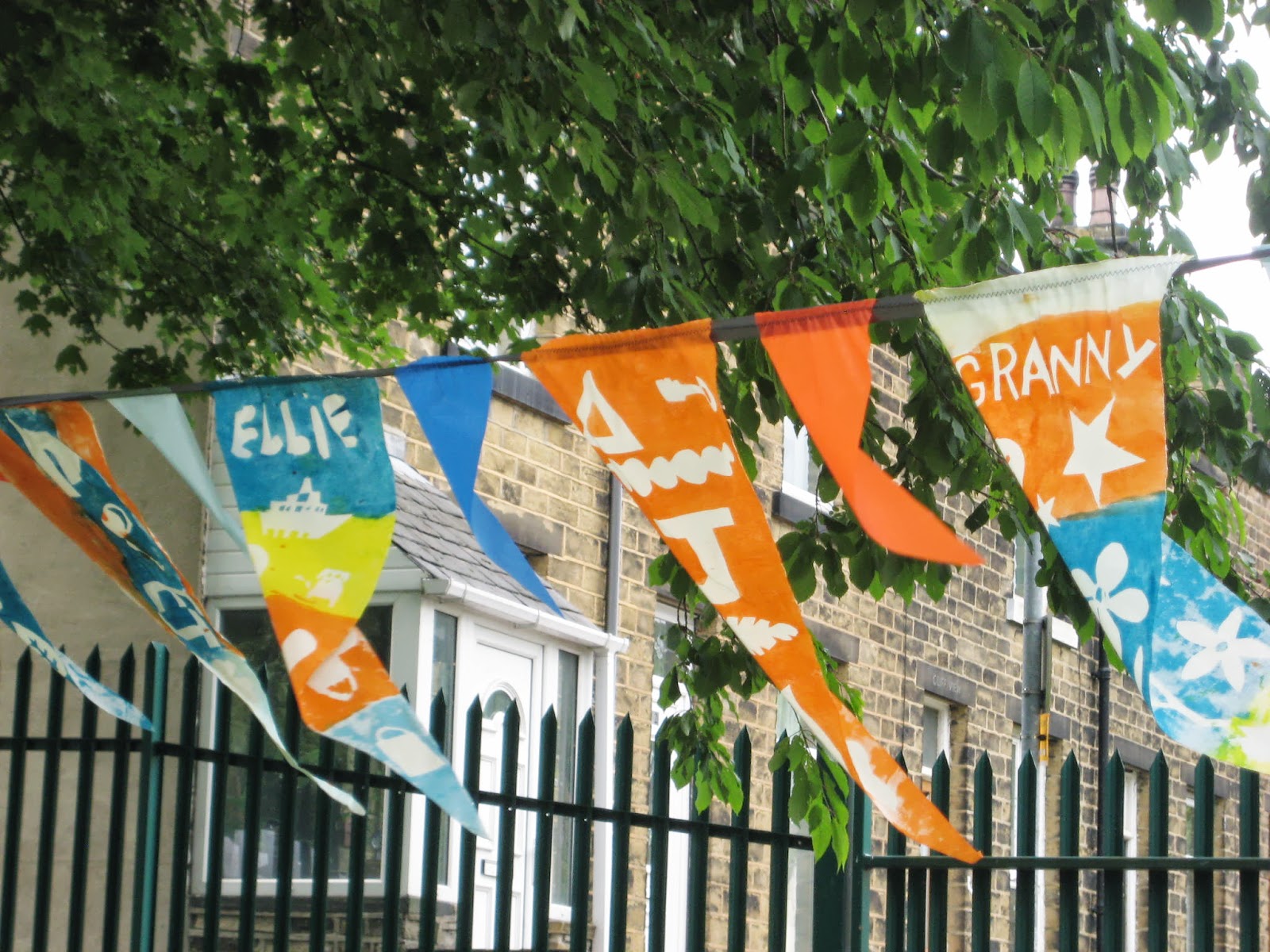
Over the last ten months the Loca Creatives team has worked alongside parents, children, teachers and local businesses to help nurture a sense of community centred in a primary school. It culminated in the school field being populated by flags and bunting that represented all the children and their families. It literally created a level playing field, a space where conversations could take place between children, parents, teachers and locals.


It is a very complex business, but helping to create such spaces is one of the ways that our work helps to make a contribution to how children succeed.